With the announcement of Citrix supporting Nutanix’s Acropolis Hypervisor in August 2015 we’ve started developing the first integration points for XenDesktop 7.6 FP3 (first supported VDA on AHV) and we started of with phase 1 (and yes, there’s more to come!) which is Citrix Power Management on AHV.
Logically we started working on some integration points and that’s what I’m showing in this video, what we’re seeing here is a Citrix XenDesktop 7.6 Feature Pack 3 environment running on Nutanix Acropolis Hypervisor, two VMs in a Machine Catalog are running on AHV and in this demo you can see that we’re able to do power management on these VMs.
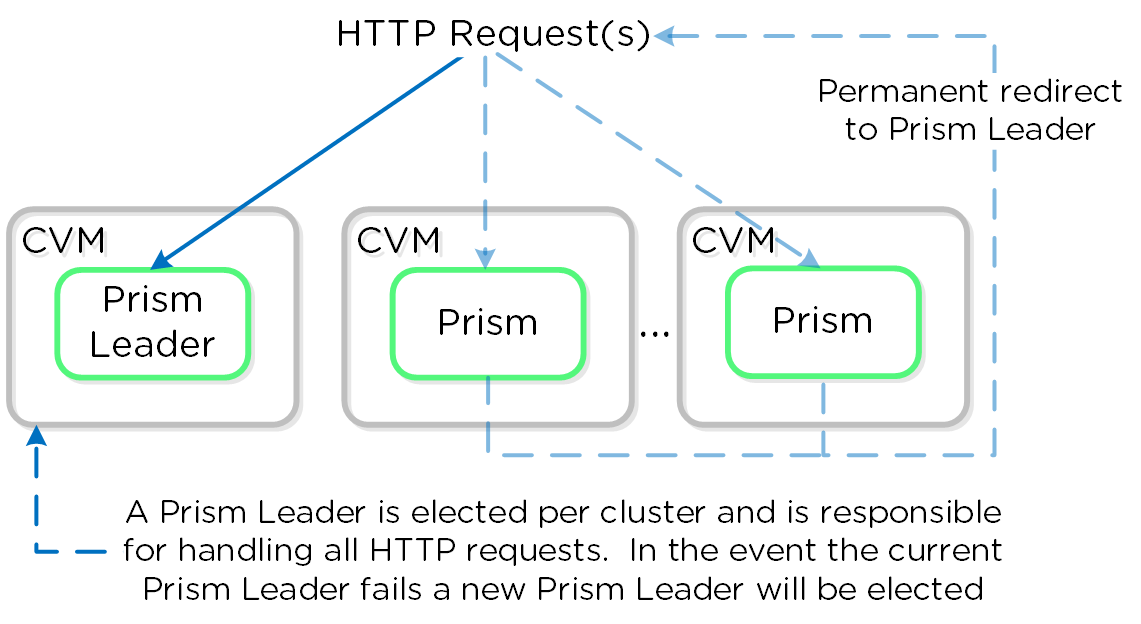
On of the things I really like in this video is that this integration allows us to utilize the Nutanix Cluster IP address, this cluster IP address is able to talk to the Prism service on the CVM that is elected as Prism leader, to clarify this I’ve included some of the wise words from the Nutanix bible:
A Prism service runs on every CVM with an elected Prism Leader which is responsible for handling HTTP requests. Similar to other components which have a Master, if the Prism Leader fails, a new one will be elected. When a CVM which is not the Prism Leader gets a HTTP request it will permanently redirect the request to the current Prism Leader using HTTP response status code 301.
Here we show a conceptual view of the Prism services and how HTTP request(s) are handled:
Prism Services – Request Handling
When using the cluster external IP (recommended), it will always be hosted by the current Prism Leader. In the event of a Prism Leader failure the cluster IP will be assumed by the newly elected Prism Leader and a gratuitous ARP (gARP) will be used to clean any stale ARP cache entries. In this scenario any time the cluster IP is used to access Prism, no redirection is necessary as that will already be the Prism Leader.
By using this mechanism you won’t have the dependency that you would normally have with vCenter or SCVMM where that specific instance can become a single point of failure in your design. Because of the ‘distributed by nature’ architecture of Nutanix you don’t have to worry about that anymore.
Kees Baggerman is Senior Technical Director — Performance & Solutions Engineering R&D at Nutanix, where he leads a global team responsible for defining how enterprise applications are delivered on the Nutanix platform. A former Citrix Technology Professional and NVIDIA Enterprise Platform Advisor, he has spent 15+ years driving EUC strategy and technical direction across architecture, product, and customer success. He has been writing here since 2011 — sharing what he learns at the intersection of platform engineering and enterprise IT.
Senior Technical Director at Nutanix - Former Citrix CTP - NVIDIA Enterprise Platform Advisor - 15+ years in EUC
Kees Baggerman is Senior Technical Director — Performance & Solutions Engineering R&D at Nutanix, where he leads a global team responsible for defining how enterprise applications are delivered on the Nutanix platform. A former Citrix Technology Professional and NVIDIA Enterprise Platform Advisor, he has spent 15+ years driving EUC strategy and technical direction across architecture, product, and customer success. He has been writing here since 2011 — sharing what he learns at the intersection of platform engineering and enterprise IT.
Daniel Feller posted another great blogpost on Virtualization Best Practices for XenApp at the Citrix Blogs One of the first questions when virtualizing XenApp is how many VMs to put on a server. Well, that was discussed in the Virtualize XenApp blog. Once you figure out how you plan to…
During one of the projects I’ve worked on we did a Citrix XenApp deployment with RES Automation Manager, as we were using building blocks the deployment was up and running in no time. The usual software was installed on this server: Office, Adobe Reader, RES Workspace Manager and some other…
A couple of months ago I wrote a blog post on VMware’s CBRC and Microsoft’s CSV Cache which are both memory caching technologies. I got a couple of questions why I didn’t write about Citrix’s Intellicache. I even got the attention of Jim Moyle and Andrew Wood , both working for Atlantis and both…
Past weekend Alex Juschin organised another E2EVC, it was the “E2EVC XX ROME” edition with 120 attendees from 18 different countries. The community mind set on this event is huge counting 20 MVPs, 16 CTPs and 6 vExperts. I was really bummed that I couldn’t attend this event in Rome as my family…
Just recently I was asked to advice in a situation with saturated lines on a Citrix XenApp 6.5 configuration with hundreds of different locations. With XenApp 6.5 and XenDesktop 5.5, with Receiver 3.0 (including Online Plugin 13.0), Citrix introduced support for true network based Quality of…
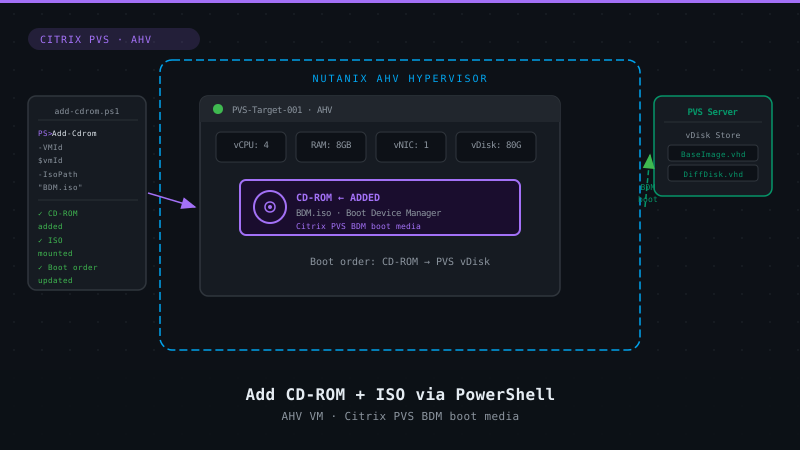
Another powershell blog? Yeah, I guess it’s that kind of a month :). After writing my previous blog on How to add a NIC via Powershell to an AHV-hosted VM I got talking to one of our Services resources about a customer trying to run Citrix PVS with BDM. I figured I could easily modify the script…
I hoped that Citrix Nutanix integrated the hypervisor in XenDesktop . But can also be seen in Version 7.8 to anything yet. Unfortunately, there is therefore no MCS.




I hoped that Citrix Nutanix integrated the hypervisor in XenDesktop . But can also be seen in Version 7.8 to anything yet. Unfortunately, there is therefore no MCS.
Remember this will be a first phase, you’ll never now what will happen in the future