Ignite 2026 Day 3 for EUC: A Quiet Thursday
Ignite 2026 for EUC, day by day
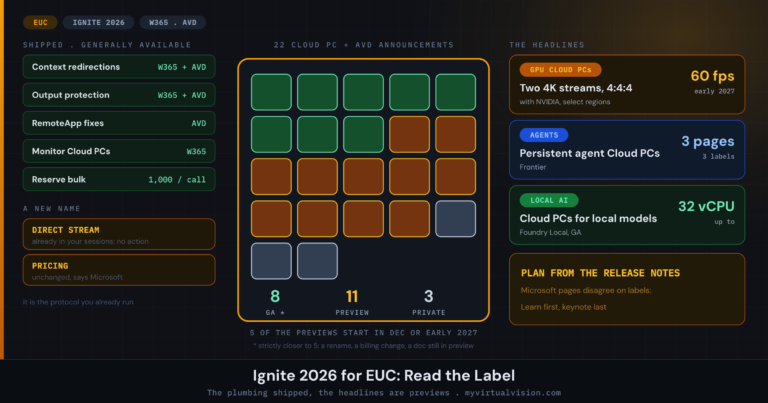
Day 1: The Plumbing Shipped, the Headlines Are Previews
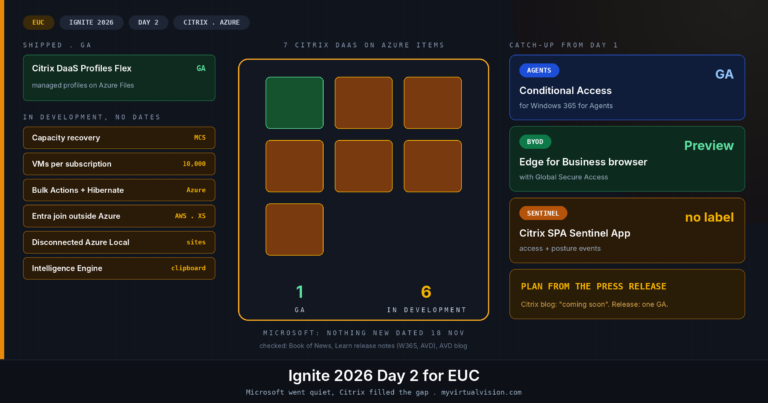
Day 2: Microsoft Went Quiet, Citrix Filled the Gap
Day 3: A Quiet Thursday (you are here)
Day 4: coming Saturday
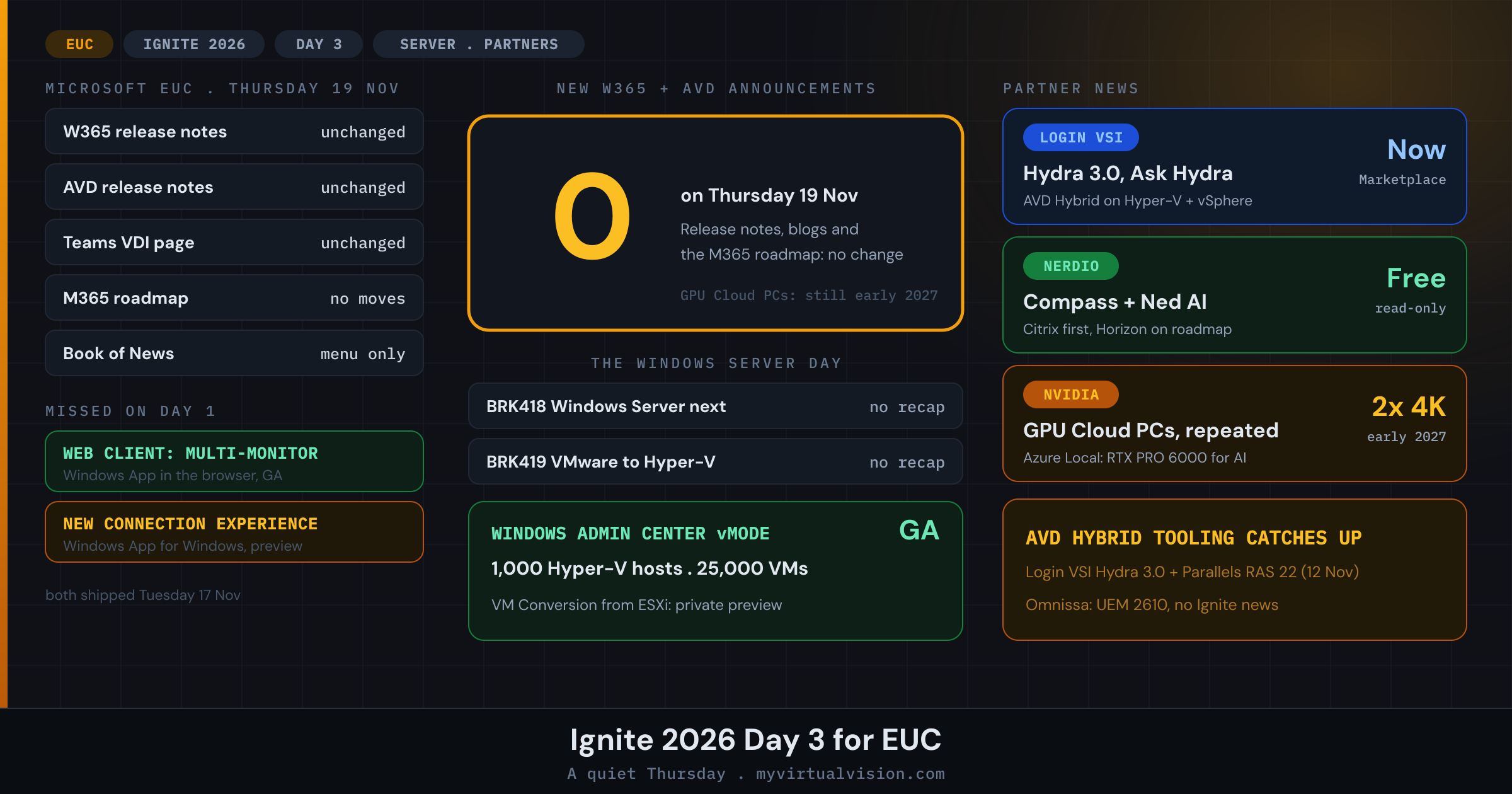
This one is short, because Thursday was short on EUC news. If the immediate thought is TL;DR, here is the conclusion upfront: Microsoft announced nothing new for Windows 365 or Azure Virtual Desktop on Day 3. Thursday was the Windows Server day at Ignite, and the partner news came from the AVD and Windows 365 tooling vendors, with Login VSI shipping Hydra 3.0 and Nerdio writing up its Compass migration assessment. I also picked up a few items from earlier in the week that I missed, the most useful one being that Windows Admin Center Virtualization Mode is now generally available.
This is event coverage, so I would rather tell you there is little to report than stretch a quiet day into a long post.
On this page
What I checked on Thursday
I went back to the same sources as on Day 1 and Day 2 and compared them with the copies I saved on Wednesday. The Book of News only changed in its site menu. The Learn release notes for Windows 365 and Azure Virtual Desktop, the Windows 365 Ignite post and the Teams VDI page had not changed at all. On the Windows IT Pro blog, the AVD blog and the Windows Experience blog, the newest EUC post is still from 17 November. The Intune team did post Intune’s journey to faster device management during the week, about faster device check-ins, but it says nothing about Cloud PCs or VDI.
I also went through the Microsoft 365 roadmap, and no Windows 365, AVD, Cloud PC, VDI or Windows App item has been changed since Tuesday. The only new EUC item of Ignite week is still the Teams VDI optimisation for Omnissa on Mac, which I covered in Day 2. The Windows 365 for Agents release notes for the week of 16 November list Copilot Credits billing and on-premises app access, which were already in Day 1, the License and utilization report from Day 1 now also covering agents, and one small change: provisioning policies for agents can now be created in a single scroll view instead of tabs.
Get new posts by email
One email when a new post goes up. Nothing else.
I only use your address to send new posts, and every email has an unsubscribe link. See the privacy policy.
Thursday was the Windows Server day
The Windows Server team had its sessions on Thursday: BRK418 on what is next for Windows Server with Neil Hinnant and Elden Christensen, BRK419 on moving from VMware to Hyper-V with Jeff Woolsey and Davanna White, and a theater session, THR897, on Azure Arc management, lower ESU costs and free hotpatching. I flagged the two breakouts in Day 2. I have not found a recording or a recap of what was actually said, so I cannot tell you yet whether Windows Server 2028 brings anything for RDS or session hosts. Until someone has watched BRK418, I would not plan Server 2028 as a session host OS based on the Day 1 preview alone.
What I did miss, because it was posted on the Windows Admin Center blog and not in the Ignite posts I followed, is that Windows Admin Center Virtualization Mode is now generally available. It shipped on 16 November as part of Windows Admin Center 2611, and Microsoft says a single instance can manage up to 1,000 Hyper-V hosts and 25,000 VMs. A day later the same team put VM Conversion in private preview inside vMode, to move VMs from VMware ESXi hosts to Hyper-V with prechecks and synchronisation ahead of the cutover.
Neither post mentions VDI, so the next part is my reading. If you run Citrix, Horizon or RDS on vSphere today and are looking at Hyper-V because of the Broadcom licensing changes, a GA management plane for Hyper-V at that scale takes away one of the bigger objections. VM Conversion is less interesting for VDI, because you would normally rebuild golden images and pools on the new hypervisor rather than convert desktops one by one, but it helps with the infrastructure servers around them.
Three Windows 365 items I missed on Day 1
All three shipped on Tuesday. Two are in the Windows App release notes, which I did not use for my Day 1 count, and one is in a paragraph of the Windows 365 post that I read past.
The first is in Windows App for the web, version 2026.0.10051.3. Multiple monitor support in the browser client is now generally available, and the web client is also generally available for AVD in Azure China, operated by 21Vianet. If you use the browser client for contractors or as a fallback when the installed client is not an option, that removes one reason to move those users to the installed client, so it is worth telling your service desk.
The second is the new connection experience in Windows App for Windows, version 2.0.1601.0, which is in public preview. It changes what users see while a session starts. Today they mostly look at a spinning indicator until the desktop is ready. In the new experience the connection window appears straight away and shows progress, errors come with clearer information about what went wrong, and a drop in connection quality shows up as a yellow pulsing border around the session. None of that makes a session start faster, but it should cut down on users clicking connect three times and then calling the service desk. The same release puts Intune app protection for Windows App in preview and brings the new connection bar, both of which were already in Day 1.
The third is about Windows 365 for Agents. The Windows 365 post names LoginVSI, WorkspaceDNA, Eido and Runbook as companies that build agents running in Cloud PCs, and quotes the founder of Eido on agents that test Windows applications and write documentation. It is a vendor quote in a Microsoft post, so I read it as a list of who to talk to, not as proof that it works at scale.
Partner news
Login VSI, the name most EUC people know from load testing, announced Hydra 3.0 on Thursday, its management layer for AVD and Windows 365, available now in Microsoft Marketplace. The headline is Ask Hydra, an assistant that answers questions about your environment in plain language, such as which session hosts had the highest round-trip time this week. It uses the AI model your organisation already deployed through Microsoft Foundry, and it pulls from AVD Insights, Log Analytics, Entra sign-in logs, FSLogix profile status, Intune and Hydra’s own agent. Login VSI calls it read-oriented in this release, so it answers questions and leaves every change to the administrator. For me the more practical items are further down the release: usage and peak concurrency reporting that includes Windows 365 Cloud PC activity, on-premises FSLogix profile storage analysis, and management of AVD Hybrid session hosts on Hyper-V and VMware vSphere through Hydra Proxy, reported the same way as hosts in Azure.
Nerdio published a blog on Nerdio Compass and Ned AI on the same day. Compass is a free, read-only SaaS assessment that discovers an existing VDI estate, scores every delivery group from 0 to 100 for both AVD and Windows 365 and shows what the estate costs to run today. Ned AI is the assistant on top, so you can ask which delivery groups are ready for AVD and what holds the others back. It also maps Citrix policies to their AVD and Windows 365 equivalents and exports published apps as AVD RemoteApps for Nerdio Manager. The catch is in the scope: Compass is deepest on Citrix today, and assessments for Omnissa Horizon, Horizon Cloud and Amazon WorkSpaces are on the roadmap, so Horizon customers cannot use it yet. Nerdio did not put out an Ignite press release, and its post-show webinar on 25 November is still the place to ask Microsoft’s product managers about open questions.
Put Hydra next to Parallels RAS 22, released on 12 November, the week before Ignite, which also adds support for AVD Hybrid environments, and you see the third-party tooling catching up with AVD Hybrid outside Azure Local. I would read that as AVD Hybrid becoming a normal migration option for on-premises estates, but check which hypervisors your tools support before you pick one.
NVIDIA posted NVIDIA and Microsoft Expand Accelerated Computing From Azure to Windows PCs. For EUC, most of it repeats the Day 1 news about GPU Cloud PCs with Direct Stream: up to two 4K streams at 60 frames per second, a limited preview you can sign up for now, and a public preview planned for early 2027. One line is new. NVIDIA says Azure Local will also support NVIDIA RTX PRO 6000 Blackwell GPUs from hardware partners. NVIDIA puts that in the context of running AI models on premises and does not mention desktops or VDI, so if you are hoping for GPU session hosts for AVD on Azure Local, that is my reading and not something NVIDIA or Microsoft said. I would wait for the Azure Local and AVD documentation before you plan hardware around it.
Omnissa published Workspace ONE UEM 2610: What’s new for your fleet on Thursday. It has nothing to do with Ignite, but if you manage Windows with Workspace ONE, two items stand out: signed resource delivery, where Intelligent Hub checks a signature on Windows apps and ADMX profiles before it applies them (Limited Availability, through your account team), and Time Windows, which now covers all Windows resource delivery and not only Freestyle Orchestrator workflows. I did not find an Omnissa announcement for Ignite.
For the rest, nothing new. Citrix’s newsroom confirms that its seven DaaS on Azure capabilities were announced on 18 November, which is what I covered in Day 2, and ControlUp and Liquidware made their announcements on Tuesday. I found no Ignite news from Dizzion, Workspot or Nutanix, which is my employer. One caveat: I could not load the Omnissa newsroom and the IGEL press page this morning, so if either of them posted something on Thursday, I have not seen it yet.
The Bottom Line
No new Microsoft EUC news on Day 3, and the partners filled in around AVD Hybrid
Microsoft’s Windows 365, AVD and Teams VDI pages did not change on Thursday, and nothing on the Microsoft 365 roadmap moved. Thursday belonged to Windows Server, with no recap yet of what it means for session hosts. Windows Admin Center Virtualization Mode went GA on 16 November, with VM Conversion from ESXi in private preview.
Login VSI shipped Hydra 3.0 with an AI assistant and AVD Hybrid on Hyper-V and vSphere, Nerdio described Compass for Citrix-to-AVD and Windows 365 assessments, and NVIDIA repeated the GPU Cloud PC news. From Day 1: multiple monitors in the Windows App web client is GA and the new connection experience in Windows App for Windows is in public preview.
What I would do: tell your service desk about multiple monitors in the web client, try the new connection experience with a small pilot group, and if you are leaving vSphere, put Windows Admin Center vMode on your evaluation list next to the AVD Hybrid tooling.
Did I miss a partner announcement from Thursday? Drop a comment below or find me on X at @kbaggerman.
Get new posts by email
One email when a new post goes up. Nothing else.
I only use your address to send new posts, and every email has an unsubscribe link. See the privacy policy.